
Special Edition: United States and Israel Strike Iran

Market Impact
The renewed conflict in the Middle East, marked by joint U.S. and Israeli strikes on Iran, has understandably unsettled financial markets and heightened uncertainty globally. In the near term, markets have reacted in a familiar risk-off pattern: global equities softened, the U.S. dollar and precious metals strengthened as safe havens, and oil prices spiked amid concerns about disruptions to the Strait of Hormuz. Higher energy prices represent the primary channel through which geopolitical tensions feed into inflation and growth expectations. If oil prices remain elevated for a prolonged period, the resulting inflationary pressures could prove detrimental to the global economy and may constrain the Federal Reserve from cutting rates, and in a more adverse scenario, could even open the door to rate hikes. While these spikes can temporarily pressure consumers and slow disinflation, the U.S. economy is far less energy-dependent than in past decades. As a net energy producer, the United States also benefits from rising oil prices, which support domestic production and investment, mitigating the broader economic impact. Historical evidence suggests that unless supply disruptions are severe and prolonged, Middle East conflicts rarely derail long-term market fundamentals.
Equity markets, both domestic and international, may continue to experience headline-driven volatility in the short term, but should stabilize as the situation becomes clearer. That said, the conflict’s duration and the potential for further U.S. involvement and resources remain uncertain. Fixed income yields could remain elevated in response to inflationary concerns, though a recessionary scenario appears unlikely at this stage. Typically, geopolitical shocks trigger a short-lived flight to safety, benefiting assets like gold, before markets refocus on core fundamentals such as earnings growth and overall economic activity, which currently remain intact. For investors, disciplined adherence to strategic asset allocation and portfolio resilience remains more critical than reactive positioning during periods of uncertainty.
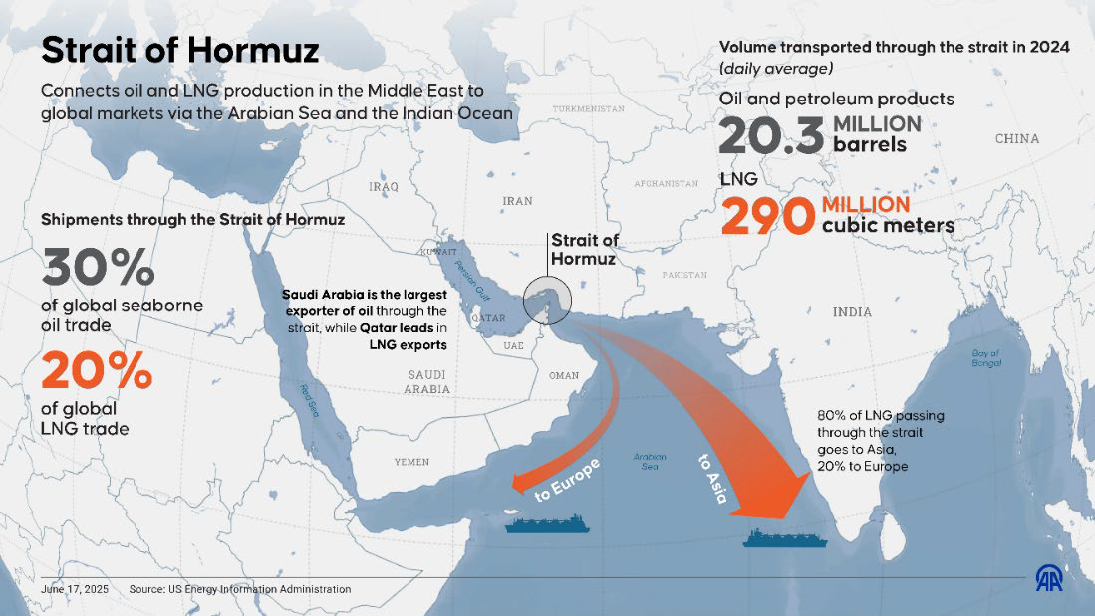
Chart 1 ¹- Strait of Hormuz
Global Impact
Iran's decision to restrict maritime traffic through the Strait of Hormuz without formally declaring a closure has effectively disrupted one of the world's most critical shipping chokepoints (Chart 1). Although Tehran has stated it does not intend to officially shut the waterway, tanker traffic has slowed sharply, insurers are withdrawing war risk coverage, and vessels are rerouting or idling amid heightening security threats.² The Strait handles roughly 30% of global seaborne oil trade and about 20% of global LNG supply³, meaning even partial disruptions inject an immediate risk premium into crude, natural gas, and refined fuel markets. Higher freight rates, elevated insurance costs, and longer shipping routes compound supply constraints, raising delivered energy costs for major importers in Asia, Europe, and beyond.
Timeline of Events
February-March 2026: After renewed but unsuccessful indirect negotiations, the United States and Israel launched coordinated strikes targeting Iranian military leadership, missile infrastructure, and nuclear-related facilities. Unlike prior limited exchanges, this was a broader campaign against strategic targets. Reports indicated significant damage in the killing of senior Iranian figures, including Iran’s supreme leader, Ayatollah Ali Khamenei, escalating tensions further.⁴ Iran retaliated with missile and drone strikes against Israeli cities and US bases in the region. Hezbollah signaled potential expansion from Lebanon, and Iran-aligned militias heightened activity in Iraq and Syria.⁵ Markets reacted sharply amid rising concerns that Iran could threaten the Strait of Hormuz, the critical choke point through which 20% of global oil supply flows.⁶
Late 2025: Following the ceasefire, Iran continued to expand uranium enrichment activity and reduced cooperation with inspectors. Diplomatic efforts failed to regain traction. Military deployments increased across the Persian Gulf, and proxy groups maintained readiness. The region entered a phase of sustained strategic instability rather than open warfare.⁷
April-June 2025: US-Iran nuclear negotiations resumed in April 2025, aimed at limiting uranium enrichment and easing sanction pressures. However, talks faltered over inspection protocols, enrichment caps, and sanctions relief⁸. In June 2025, Israel launched major strikes on Iranian military and nuclear facilities, and the confrontation became known as the Twelve-Day War. The United States formally entered the conflict on June 21, with air strikes on Fordow, Natanz, and Isfahan, marking the first large-scale conventional US strike on Iranian nuclear infrastructure in this cycle. Although officials described significant damage, intelligence assessments later suggested Iran's nuclear program was set back but not eliminated.⁹ Iran responded with missile strikes on US regional assets, including Al Udeid Air Base in Qatar. A cease-fire was brokered on June 24th, halting the immediate fighting, but the conflict's character had changed permanently.¹⁰
October 2024: Israel conducted air and missile strikes inside Iran, targeting missile production facilities and air defense systems. Iran responded with ballistic missile attacks on Israeli territory, further normalizing direct military exchanges between the two states. At this point, the conflict moved beyond episodic retaliation and into a pattern of direct deterrence signaling. Hezbollah remained active along the northern Israeli border, maintaining pressure and keeping escalation risk elevated¹¹.
April 2024: Israel was accused of bombing an Iranian embassy in Syria. The airstrike destroyed the consulate building in the capital city of Damascus, killing at least seven officials, including a top commander in Iran’s elite Revolutionary Guards (IRGC). Israel neither confirmed nor denied responsibility for the attack. But this only intensified the military campaign. Iran retaliated by launching hundreds of drones toward Israel in an attack. It is the first time that Iran has launched an attack on Israel from Iranian soil.¹²
Late 2023 and Early 2024: International efforts to mediate a ceasefire began to gain momentum amid rising global concern over the humanitarian crisis in Gaza and the escalating death toll. However, a peaceful resolution was never reached.
October 7, 2023: An Iran-backed military group (Hamas) launched an attack on Israel, which killed over 1,200 people and saw more than 240 taken hostage. Although the conflict between Israel and Palestine had been ongoing for years, this marked the most severe invasion of Israeli territory since 1948.¹ To which Israel responded with significant military strikes aimed at Hamas and other militant targets in Gaza (a densely populated Palestinian area), initiating a blockade of essential supplies to the Gaza Strip and further escalating tensions in the Middle East.
Disclosures
The statements provided herein are based solely on the opinions of the Osaic Research Team and are being provided for general information purposes only. Neither the information nor any opinion expressed constitutes an offer or a solicitation to buy or sell any securities or other financial instruments. Any opinions provided herein should not be relied upon for investment decisions and may differ from those of other departments or divisions of Osaic Wealth, inc. (“Osaic”) or its affiliates.
Certain information may be based on information received from sources the Osaic Research Team considers reliable; however, the accuracy and completeness of such information cannot be guaranteed. Certain statements contained herein may constitute “projections,” “forecasts” and other “forward-looking statements” which do not reflect actual results and are based primarily upon applying retroactively a hypothetical set of assumptions to certain historical financial information. Any opinions, projections, forecasts and forward-looking statements presented herein reflect the judgment of the Osaic Research Team only as of the date of this document and are subject to change without notice. Osaic has no obligation to provide updates or changes to these opinions, projections, forecasts and forward-looking statements. Osaic is not soliciting or recommending any action based on any information in this document.
Securities and investment advisory services are offered through the firms: Osaic Wealth, Inc. and Osaic Institutions, Inc., brokerdealers, registered investment advisers, and members of FINRA and SIPC. Securities are offered through Osaic Services, Inc. and Ladenburg Thalmann & Co., broker-dealers and members of FINRA and SIPC. Advisory services are offered through Ladenburg Thalmann Asset Management, Inc., Osaic Advisory Services, LLC. and CW Advisors, LLC., registered investment advisers. Advisory programs offered by Osaic Wealth, Inc. are sponsored by VISION2020 Wealth Management Corp., an affiliated registered investment adviser.
______
1 https://www.cnbc.com/2026/03/02/strait-of-hormuz-crisis-us-iran-israel-war-shipping-trade-oil.html
2 https://www.spglobal.com/energy/en/news-research/latest-news/crude-oil/022826-iran-claims-hormuz-is-shut-down-after-irgc-threat-to-shipping-tasnim
3 https://www.eia.gov/todayinenergy/detail.php?id=65504#:~:text=The%20Strait%20of%20Hormuz%2C%20located,of%20global%20petroleum%20liquids%20consumption
4 https://www.foxnews.com/world/dozens-top-iranian-regime-officials-supreme-leader-killed-israeli-strikes
5 https://www.idahostatejournal.com/news/local/war-widens-to-include-iranian-backed-militias-as-israeli-and-american-planes-pound-iran/article_2ceb8ddc-cf7b-4c8d-8d98-c6e929498824.html
6 https://www.foxnews.com/world/strait-hormuz-maritime-incidents-follow-us-israeli-operation-epic-fury-strikes-iran
7 https://www.pbs.org/newshour/world/irans-president-suspends-cooperation-with-un-nuclear-watchdog-after-u-s-and-israeli-strikes
8 https://www.pbs.org/newshour/world/iran-and-u-s-hold-a-fifth-round-of-nuclear-negotiations-in-rome-with-enrichment-a-key-issue-
9 https://www.nbcnews.com/politics/national-security/new-us-assessment-finds-american-strikes-destroyed-only-one-three-iran-rcna218761
10 The Iran–Israel Ceasefire of 2025: What Happened, Why It Matters, and What Comes Next – The Word 360
11 https://www.livenowfox.com/news/israel-launches-attack-iran
12 https://www.npr.org/2024/04/13/1244641489/iran-israel-drone-attack-middle-east-gaza
8801751