
Show Me The Money: The Age of Mega IPOs

What is an Initial Public Offering?
An Initial Public Offering (IPO), is the process by which a private company becomes a public company through the sale of equity shares on a public exchange, such as the New York Stock Exchange (NYSE) or the National Association of Securities Dealers Automated Quotations (NASDAQ). Most private companies begin small with ownership limited to a few founders and early investors. As a company grows, many founders look to monetize their ownership by selling a portion of the company. An IPO, sometimes referred to as “going public,” allows a founder to sell shares on a regulated exchange by other market participants.
What is special about today’s IPOs?
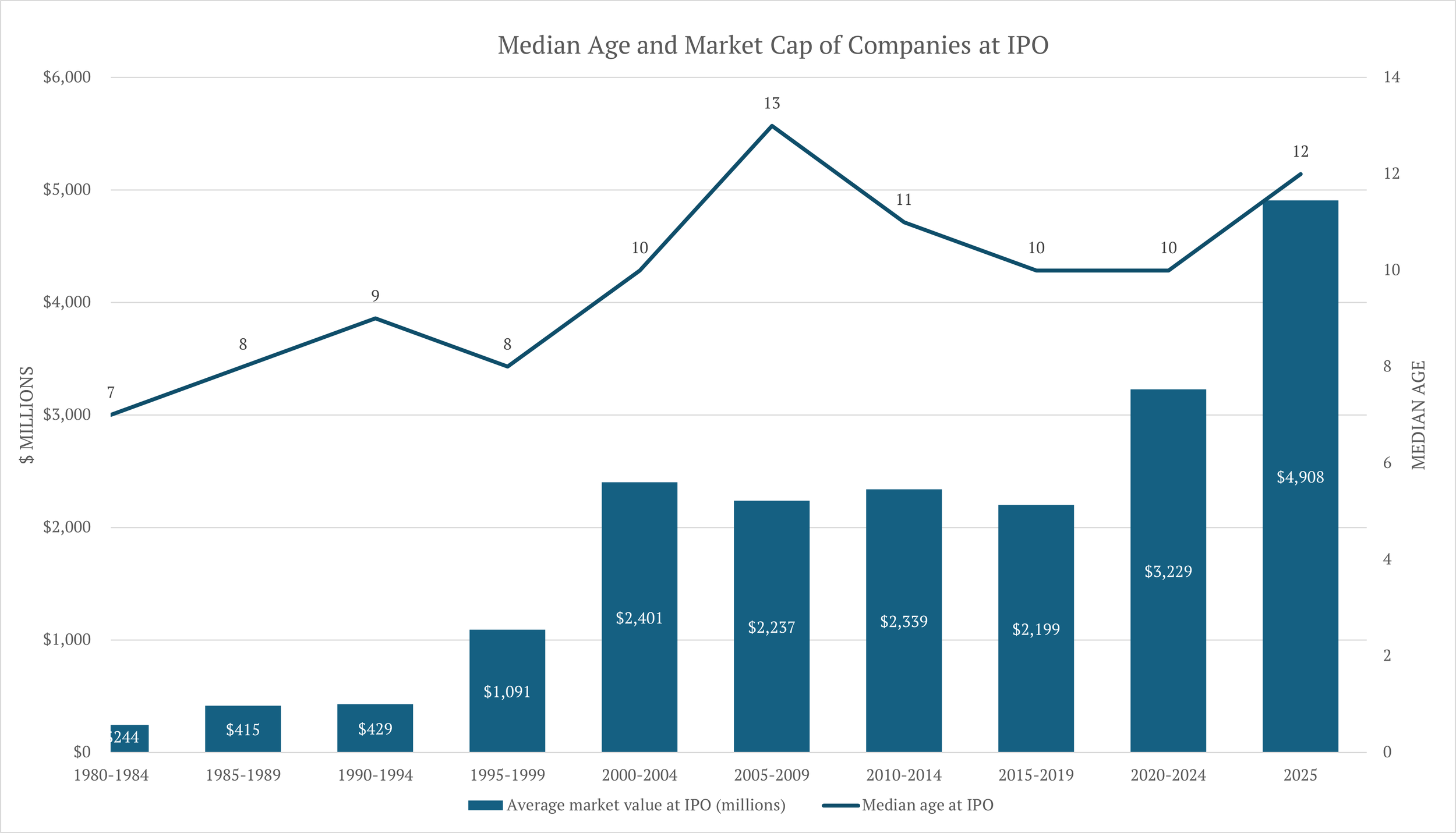
The blue bars in Chart 1¹ show the average size of a company at the time it goes public, and the black line shows the average age at the time of the offering. The chart indicates two things: companies are staying private longer and coming to market much bigger. In the past 25 years alone, the average IPO has grown in size by more than 10x, and the average company stayed private for 33% longer.
In 2026, however, SpaceX is expected to go public with an estimated market capitalization of $1.25 trillion.² This would make it by far the largest IPO ever, but other major offerings from Anthropic and OpenAI are expected to follow soon after.³ A big reason companies are staying private longer and delaying IPOs until they are larger is that they have much greater access to private capital and don’t need to raise money from Wall Street to support expanding operations or fund future growth.
CHART 1: Median Age and Market Cap of Companies at IPO
Source: Warrington College of Business, IPO Statistics
What does this mean for financial markets?
By total company size, there are thirteen publicly traded companies valued at over $1 trillion, so SpaceX's IPO, at current estimates, would already make it one of the largest companies in the world. The largest companies, such as Nvidia, Google, and Apple, typically make up the largest portion of stock market indices, like the S&P 500, NASDAQ 100, or Russell 1000, which are widely held by investors of all sizes. Investors, however, will likely not see companies like SpaceX be as large in the S&P 500 as other mega-cap tech behemoths.
A company’s size is usually measured by market capitalization, which is the total value of the company’s equity, calculated by multiplying the current share price by the total number of shares. For SpaceX, this is estimated to be around $1.25 trillion. What indices like the S&P 500 emphasize is the amount of equity that is floating. The float refers to the amount of equity available to the public, i.e., not held by any government, founder, or company executive, because those shares are not available for regular investors to buy.
For many companies, the two are synonymous. Disney, McDonald's, Microsoft, and many other publicly traded companies have over 99% of their shares floating. This means their position in the S&P 500 is accurately reflected by their market capitalization, since it is essentially equal to their float. Companies like Walmart and T-Mobile have only about 50% of their shares floating, so although they are both large companies, they will be weighted lower in the S&P 500 because their float-adjusted market capitalization is smaller.
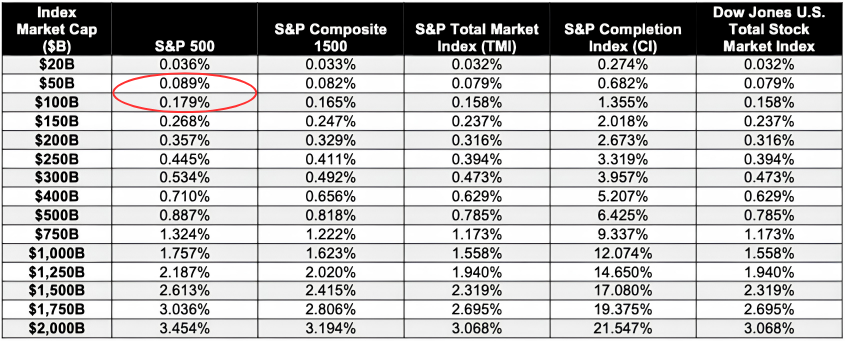
In terms of SpaceX, the estimated float is between $75 - $90 billion, a very small percentage of the overall market cap, so its weighting across the major indices is expected to be small.⁴ Chart 2⁵ shows the float-adjusted market cap, and the red circle estimates where SpaceX will be sized in the S&P 500. Furthermore, each index has its own prerequisites for audited financial statements or tenure as a publicly traded company. For instance, companies must be publicly listed for at least 12 months before becoming eligible for inclusion in the S&P 500, currently, but S&P Dow Jones Indices is considering a proposal to shorten that requirement to as little as 6 months for certain mega-cap IPOs.⁶
CHART 2: Estimated Weight at Difference Company Level FMC
Source: NextBigFuture.com
Conclusion
Companies are going public at larger valuations, but that does not guarantee investors will gain proportional exposure right away. Because of nuanced index rules and the limited number of shares initially available for public purchase, investors should not expect significant exposure to new mega IPOs, despite the overall size of the companies. While indices may seem rigid and inflexible, they continue to involve carefully and methodically. And given the typically high volatility profile of new offerings, index providers will likely adapt gradually to the age of mega IPOs.
The statements provided herein are based solely on the opinions of the Osaic Research Team and are being provided for general information purposes only. Neither the information nor any opinion expressed constitutes an offer or a solicitation to buy or sell any securities or other financial instruments. Any opinions provided herein should not be relied upon for investment decisions and may differ from those of other departments or divisions of Osaic Wealth, inc. (“Osaic”) or its affiliates. Certain information may be based on information received from sources the Osaic Research Team considers reliable; however, the accuracy and completeness of such information cannot be guaranteed. Certain statements contained herein may constitute “projections,” “forecasts” and other “forward-looking statements” which do not reflect actual results and are based primarily upon applying retroactively a hypothetical set of assumptions to certain historical financial information. Any opinions, projections, forecasts and forward-looking statements presented herein reflect the judgment of the Osaic Research Team only as of the date of this document and are subject to change without notice. Osaic has no obligation to provide updates or changes to these opinions, projections, forecasts and forwardlooking statements. Osaic is not soliciting or recommending any action based on any information in this document. Securities and investment advisory services are offered through the firms: Osaic Wealth, Inc. and Osaic Institutions, Inc., broker-dealers, registered investment advisers, and members of FINRA and SIPC. Securities are offered through Osaic Services, Inc. and Ladenburg Thalmann & Co., broker-dealers and members of FINRA and SIPC. Advisory services are offered through Ladenburg Thalmann Asset Management, Inc., Osaic Advisory Services, LLC. and CW Advisors, LLC., registered investment advisers. Advisory programs offered by Osaic Wealth, Inc. are sponsored by VISION2020 Wealth Management Corp., an affiliated registered investment adviser.
1 Warrington College of Business - IPO-Statistics_1980-2025
2 SpaceX IPO prospectus could land as soon as next week, sources say
3 SpaceX, OpenAI, and Anthropic: Here are the most anticipated IPOs in 2026
4 SpaceX IPO: How the 5% Float and Lock-Up Waiver Shape Retail Risk | The Insight Feed
5 Rule Change so SpaceX Should Join Sp500 6 Months After IPO | NextBigFuture.com
6 S&P Weighs New Index Rules to Speed Up Addition of Mega IPOs
8942890