
Russia’s Diminishing Influence: Numbers Versus Narrative
Introduction
For decades, Russia has been seen as a global superpower with formidable military strength and geopolitical influence, a legacy dating back to the Cold War. However, an analysis of the country’s economic, demographic, and military fundamentals tells a more nuanced story, suggesting its long-term strength may be considerably weaker than commonly perceived. It has been more than four years since Russian forces crossed into Ukraine, straining its military capabilities, weighing on economic growth, and challenging its position on the global stage. Yet Russia's relative decline did not just begin in 2022. Even before the invasion, the country was grappling with sluggish economic growth, demographic headwinds, and a diminishing role in the global economy relative to both other developed nations and the influence it once wielded at the height of the Soviet Union era.
Economy
The Russian economy expanded rapidly in the early 2000s following the dissolution of the Soviet Union and the transition toward market-based reforms along with higher oil prices. However, more recent growth has largely stalled over the past decade. In 2012, Russia’s gross domestic product (GDP) stood at approximately $2.21 trillion in current U.S. dollars, and as of 2024 it was $2.17 trillion, indicating that economic growth has remained broadly unchanged for more than 10 years. In comparison the United States has a GDP of $30.76 trillion.¹ In fact, both California and Texas now have larger economies than Russia, and it also ranks below major economies such as Japan and India. The disparity underscores the growing gap between Russia’s reputation as a global power and the economic scale typically associated with that status.
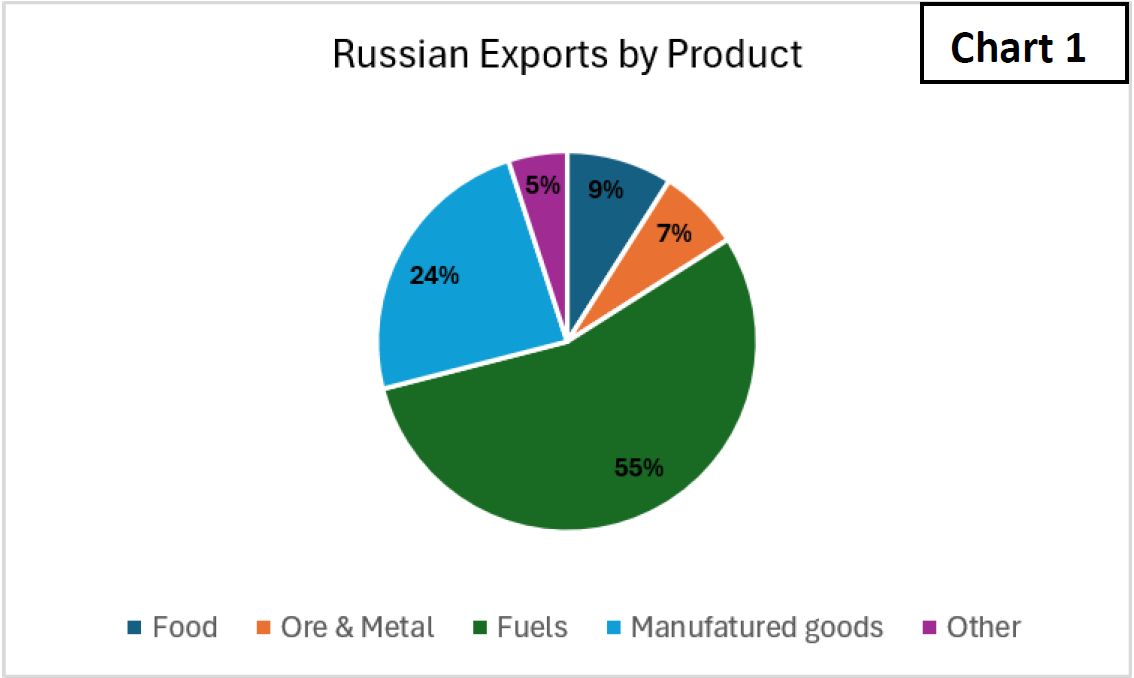
Chart 1 | Russian Exports by Product
A key constraint on Russia’s long-term growth has been its heavy reliance on oil and gas exports alongside underinvestment in broader sectors such as tech and digital services. As energy prices have moderated over the past decade, economic momentum has followed a similar trajectory, with gas and oil accounting for the majority of export revenues. In 2024, approximately 55% of Russia’s total exports were derived from fuel products as shown in Chart 1.² Additionally, outside investment has declined to levels not seen since the early 2000s, following sanctions imposed after the 2014 annexation of Crimea and further reinforced after the 2022 invasion of Ukraine. These measures significantly reduced Russia’s access to global capital markets and advanced technology. As a result, economic dependence on government support has increased, and a 2023 report noted that the country's five largest investors accounted for nearly 20% of the total investment. All of which were either directly or indirectly owned by the government, highlighting the economy's increasing reliance on the state rather than on diversified private-sector growth.³
Demographics
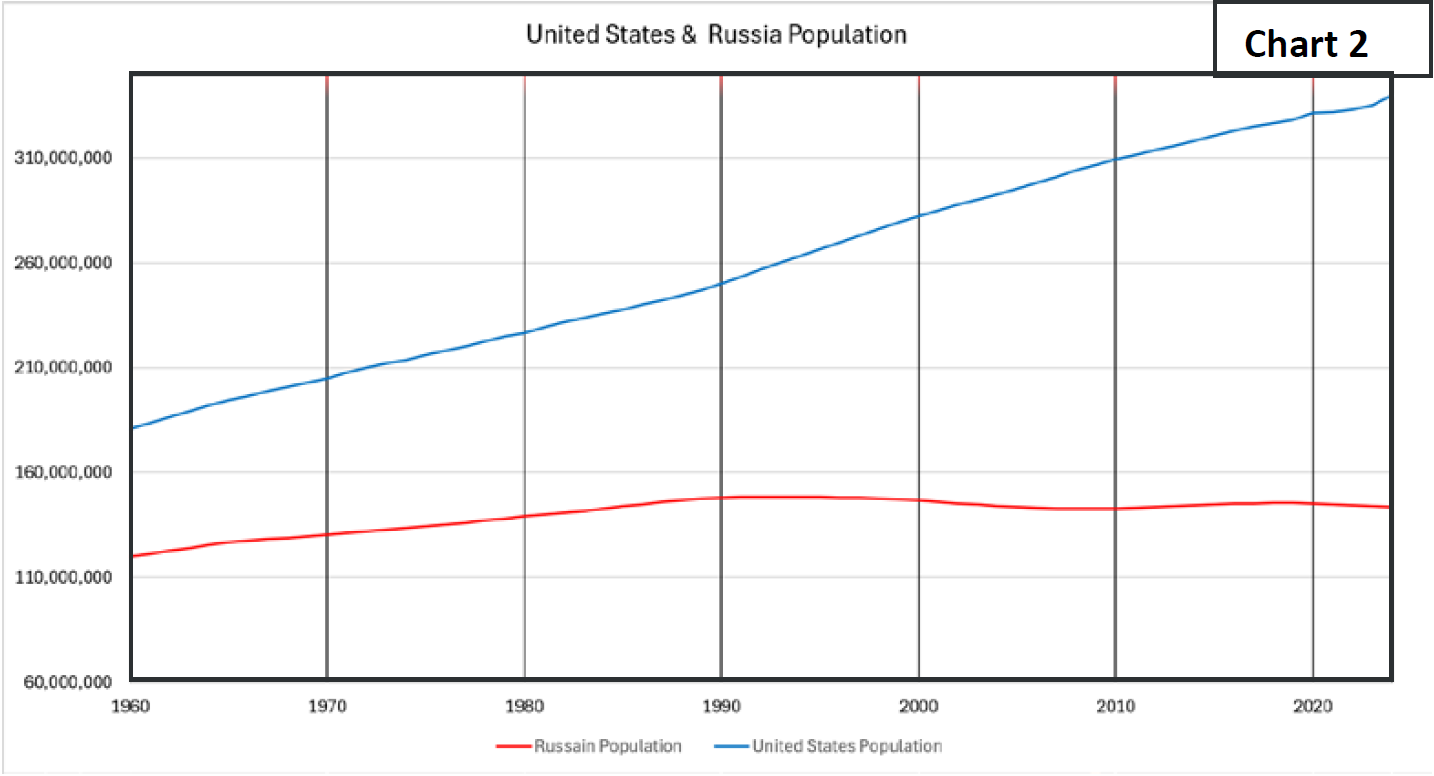
Russia’s population currently stands at 144 million, which is less than half the U.S. population of 344 million, as shown in Chart 2.⁴ While many developed nations are experiencing slower population growth, Russia is experiencing a population decline. The country's population peaked at approximately 148.5 million people in 1992 and has gradually fallen to roughly 144 million today. More concerning, Russia has recorded population declines in each of the past seven years, as there has been a sharp deterioration in birth rates, with births recently falling to their lowest levels in more than two centuries.⁵ In 2024, approximately 1.22 million births were recorded compared to 1.86 million deaths. Russia's aging and shrinking population is further compounded by a relatively low life expectancy. At 73.7 years, Russia ranks 107th out of 197 countries, placing it well behind most developed economies.⁶ Additionally, health and social factors continue to weigh on demographics, with Russia's alcoholism rate estimated to be 4.6% of the population, nearly double that of the United States, despite having less than half the population.
Military
While Russia continues to be viewed as one of the world’s premier military powers, its conventional capacity is considerably smaller than that of the United States and more constrained than its global reputation might suggest. The war in Ukraine has placed a significant strain on Russia's military capabilities and resources. According to various estimates, Russian casualties, including both those killed and wounded, have exceeded 800,000 personnel since the start of the conflict. While Russia maintains one of the world's largest standing militaries, with approximately 1.3 million active-duty personnel, it lacks significant resources relative to the U.S.⁷ Russia spent approximately $190 billion on defense in 2025, representing roughly 7.5% of its GDP. While this ranks among the highest military expenditures globally and trails only the United States and China in total spending, the gap between Russia and the United States remains substantial. For comparison, the United States spent approximately $954 billion on defense in the same year.⁸ Russia also has significantly fewer naval and air force craft than the United States. As an example, Russia's air force operates approximately 3,677 aircraft, compared with more than 13,052 aircraft under U.S. control.⁹ However, one area where Russia continues to maintain superiority is its nuclear weapons. Russia possesses the world's largest stockpile of nuclear warheads, estimated at approximately 5,459, slightly exceeding the United States' estimated inventory of 5,177 warheads.¹⁰ Although Russia's conventional military capabilities may be more limited than commonly perceived, its nuclear deterrent remains a critical factor supporting its status as a major global power.
Conclusion
For decades, Russia has been viewed as one of the world's great powers, but the underlying data reveals a nation facing significant structural challenges. Its economy has struggled to grow for more than a decade, its population is shrinking, and the war in Ukraine has exposed limitations in both its military capabilities and economic resilience. At the same time, Russia's geopolitical influence has weakened as key partners and allies, including Syria, Iran, Venezuela, and Cuba, have experienced significant setbacks. While Russia remains an important player on the global stage, supported in part by its nuclear arsenal and natural resources, the evidence suggests that the gap between perception and reality has widened, leaving its long-term influence considerably weaker than commonly assumed.
The statements provided herein are based solely on the opinions of the Osaic Research Team and are being provided for general information purposes only. Neither the information nor any opinion expressed constitutes an offer or a solicitation to buy or sell any securities or other financial instruments. Any opinions provided herein should not be relied upon for investment decisions and may differ from those of other departments or divisions of Osaic Wealth, inc. (“Osaic”) or its affiliates.
Certain information may be based on information received from sources the Osaic Research Team considers reliable; however, the accuracy and completeness of such information cannot be guaranteed. Certain statements contained herein may constitute “projections,” “forecasts” and other “forward-looking statements” which do not reflect actual results and are based primarily upon applying retroactively a hypothetical set of assumptions to certain historical financial information. Any opinions, projections, forecasts and forward-looking statements presented herein reflect the judgment of the Osaic Research Team only as of the date of this document and are subject to change without notice. Osaic has no obligation to provide updates or changes to these opinions, projections, forecasts and forward-looking statements. Osaic is not soliciting or recommending any action based on any information in this document.
Investing involves risk, including the potential loss of principal. No investment strategy can guarantee a profit or protect against loss. In general, the bond market is volatile; bond prices rise when interest rates fall and vice versa. This effect is usually pronounced for longerterm securities. Any fixed-income security sold or redeemed prior to maturity may be subject to a substantial gain or loss. Vehicles that invest in lower-rated debt securities (commonly referred to as junk bonds or high-yield bonds) involve additional risks because of the lower credit quality of the securities in the portfolio. International investing involves special risks not present with U.S. investments due to factors such as increased volatility, currency fluctuation, and differences in auditing and other financial standards. These risks can be accentuated in emerging markets.
Index performance does not reflect the deduction of any fees and expenses, and if deducted, performance would be reduced. Indexes are unmanaged and investors are not able to invest directly into any index. Past performance cannot guarantee future results.
Trading in Forecast Contracts is highly speculative and involves a high degree of risk. You may lose all funds used to enter a Forecast Contract. Market participants' expectations may not match the actual outcome of the Event, which can lead to unexpected losses. Exchanges have the authority to initiate trading halts if they deem it in the interest of Market Participants, which could prevent you from exiting positions. The value of an Event Contract depends on the outcome, typically reported by a third party. Market participants may be exposed to risk if this source reports inaccurate data or fails to report the data.
Securities and investment advisory services are offered through the firms: Osaic Wealth, Inc. and Osaic Institutions, Inc., broker-dealers, registered investment advisers, and members of FINRA and SIPC. Securities are offered through Osaic Services, Inc. and Ladenburg Thalmann & Co., broker-dealers and members of FINRA and SIPC. Advisory services are offered through Ladenburg Thalmann Asset Management, Inc., Osaic Advisory Services, LLC. and CW Advisors, LLC., registered investment advisers. Advisory programs offered by Osaic Wealth, Inc. are sponsored by VISION2020 Wealth Management Corp., an affiliated registered investment adviser.
1 GDP (current US$) - Russian Federation | Data
3 Investment patterns reflect Russia’s war of aggression
4 Russia Population | Historical Data | Chart | 1950-2026
5 Russia’s Birth Rate Plunges to 200-Year Low - The Moscow Times
6 Russia: Life Expectancy 1950-2026 & Calculator by age
7 Russia Military Spending 2025: $190B Defense Budget | MilitarySpend
8 Russia Military Spending 2025: $190B Defense Budget | MilitarySpend
9 Russia Military Spending 2025: $190B Defense Budget | MilitarySpend
10 Nuclear Weapons by Country 2026
8990780