
Prediction Markets: “Pricing the Future”?

Prediction markets are exchanges where users buy and sell contracts, often called event contracts, that are tied to the outcomes of future real-world events. Over the last few years, these ‘bet-on-anything’ platforms have grown in popularity and scale. From early 2024 through November 2025, monthly volume in prediction markets surged 130x, from under $100 million to over $13 billion.¹ The largest players, Kalshi and Polymarket, have each reached multibillion-dollar valuations in recent months. Despite this rise, many remain wary that these speculative markets resemble traditional gambling more than investing. In fact, regulators in the UK treat prediction markets like betting exchanges, requiring a gambling license, rather than financial oversight.² Despite their explosive growth, these platforms still face a complex and rapidly evolving regulatory framework, limited safeguards against insider trading, and ongoing concerns around market fairness.
Co-founder and chief executive of Kalshi, Tarek Mansour, envisions a brighter future for prediction markets and society at large, saying in a recent interview, “We’re making the world a little bit smarter about the future, and I think that’s a very valuable thing to build.” He went on to caution, “It’s not something that you should take as the Holy Grail truth, but it’s better than the alternatives.”³ Prediction markets serve legitimate purposes beyond pure speculation, allowing investors to hedge portfolio exposures against political, economic, and regulatory risks, using real-time crowd sourced signals. A major catalyst that contributed to the rise of prediction markets was the run-up to the 2024 U.S. presidential election, when bets placed at competitor Polymarket clearly predicted the eventual outcome, a decisive win for Donald Trump, while opinion polls predicted a much tighter race.
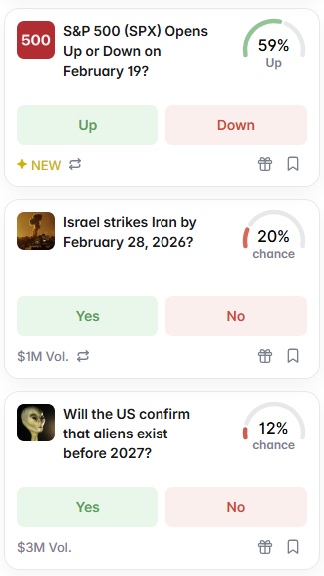
Chart 1 | Table Stakes, Empower
Everything from inflation readings and election results to whether the U.S. will strike Iran or Taylor Swift will announce a pregnancy is on the betting table. Essentially, anything that draws enough public attention can be bet on. Instead of betting with fixed odds, like a sportsbook, users trade shares that rise and fall based on how likely the market believes an event is to occur. Contracts are generally structured as yes-or-no questions: “Will the Federal Reserve (Fed) cut rates in March?” or “Will Jesus Christ return before 2027?” (yes, both real contracts trading today), and each contract typically pays $1 if the event happens and $0 if it does not. Instead of buying shares in a company, users are buying probability. A contract priced at $0.88 indicates that users collectively assign an 88% chance that the event will occur. If the event does occur, YES contracts purchased at $0.88 receive $1 and profit $0.12. If the event does not occur, YES contracts lose the $0.88 while NO contracts purchased at $0.12 receive $1 and profit $0.88.⁴ Although yes-or-no contracts are the most common, markets can be structured in several formats, including: multiple-selection markets, where multiple possible outcomes exist for a single event, like elections; continuous forecasting markets, which are tied to a range of numerical outcomes, e.g., “What will the next CPI reading be?”; and conditional markets that feature contracts dependent on another event occurring first.⁵ The possibilities are, quite literally, endless.
Despite recent attention and discussion around politics and pop-culture predictions, sports still dominates the trading on predictions markets. On Kalshi, over 90% of all trading is sports-related. Polymarket is more mixed, but still about half of its overall trading activity is tied to sports. Traditional sports betting companies like DraftKings, and the parent company for FanDuel, Flutter Entertainment, have seen share prices underperform significantly in the past few years as prediction markets emerge as an alternative to traditional sports betting platforms.
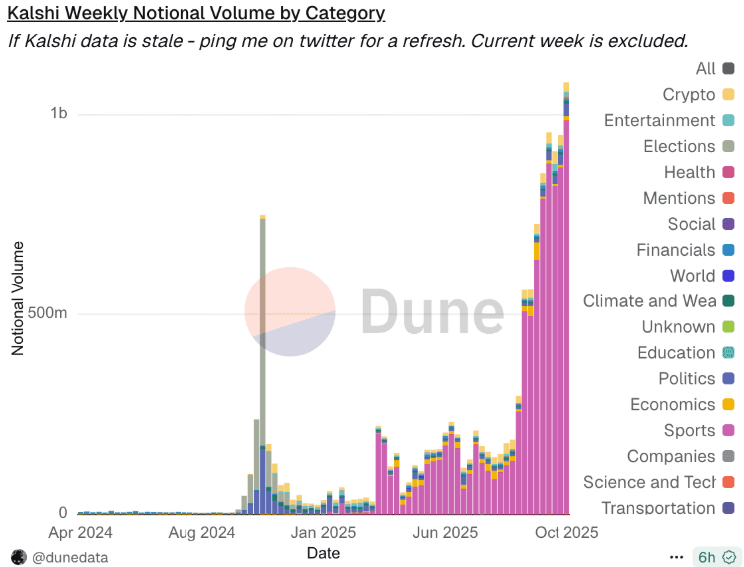
Growth in these markets has been astronomical as well. Kalshi processed over $23.8 billion in total volume in 2025, representing year-over-year growth in excess of 1,100%.⁶ Polymarket has seen similar explosive growth in recent years despite being banned from operating in the U.S. from January 2022 through October of last year. Overall, annual trading volume for the industry grew by roughly 4x in the last year, from $15.8 billion in 2024 to $63.5 billion in 2025.⁷ Eilers & Krejcik, a research firm that specializes in sports and interactive gaming sectors, projects that prediction markets could reach $1 trillion in annual trading volume by the end of the decade,⁸ and Citizens Financial Group forecasts prediction market revenues will grow to over $10 billion in the same time, from roughly $2 billion today.
The regulatory landscape is also evolving rapidly and is arguably the most critical factor facing the industry today. President Trump appointed Michael Selig as Chairman of the Commodity Futures Trading Commission (CFTC), which currently regulates prediction markets. The new chairman outlined a four-part agenda to guide future regulation last month.⁹ This agenda withdrew prior restrictions, reassessed pending lawsuits, announced plans for new rulemaking aimed at establishing clear standards, and reaffirmed prediction markets as commodity derivatives.¹⁰ Undoubtedly, rules and regulations will continue to evolve, and courts will eventually rule on multiple legal challenges to the federal framework, but the current administration remains supportive of these markets.
While there is still a lot to figure out, the tremendous potential for rapid growth in an entirely new industry where everything can be a tradable asset is truly exciting. However, one key unknown is the tax treatment of prediction market returns and profits, as the Internal Revenue Service (IRS) has not yet issued specific guidance, making professional advice essential for frequent users.¹¹ Prediction market participants also face many of the typical trading risks (liquidity, leverage, overconfidence), as well as a few unique structural challenges. Still, in a world where everything is now tradable, the opportunities are endless.
The statements provided herein are based solely on the opinions of the Osaic Research Team and are being provided for general information purposes only. Neither the information nor any opinion expressed constitutes an offer or a solicitation to buy or sell any securities or other financial instruments. Any opinions provided herein should not be relied upon for investment decisions and may differ from those of other departments or divisions of Osaic Wealth, inc. (“Osaic”) or its affiliates.
Certain information may be based on information received from sources the Osaic Research Team considers reliable; however, the accuracy and completeness of such information cannot be guaranteed. Certain statements contained herein may constitute “projections,” “forecasts” and other “forward-looking statements” which do not reflect actual results and are based primarily upon applying retroactively a hypothetical set of assumptions to certain historical financial information. Any opinions, projections, forecasts and forward-looking statements presented herein reflect the judgment of the Osaic Research Team only as of the date of this document and are subject to change without notice. Osaic has no obligation to provide updates or changes to these opinions, projections, forecasts and forward-looking statements. Osaic is not soliciting or recommending any action based on any information in this document.
Investing involves risk, including the potential loss of principal. No investment strategy can guarantee a profit or protect against loss. In general, the bond market is volatile; bond prices rise when interest rates fall and vice versa. This effect is usually pronounced for longerterm securities. Any fixed-income security sold or redeemed prior to maturity may be subject to a substantial gain or loss. Vehicles that invest in lower-rated debt securities (commonly referred to as junk bonds or high-yield bonds) involve additional risks because of the lower credit quality of the securities in the portfolio. International investing involves special risks not present with U.S. investments due to factors such as increased volatility, currency fluctuation, and differences in auditing and other financial standards. These risks can be accentuated in emerging markets.
Index performance does not reflect the deduction of any fees and expenses, and if deducted, performance would be reduced. Indexes are unmanaged and investors are not able to invest directly into any index. Past performance cannot guarantee future results.
Trading in Forecast Contracts is highly speculative and involves a high degree of risk. You may lose all funds used to enter a Forecast Contract. Market participants' expectations may not match the actual outcome of the Event, which can lead to unexpected losses. Exchanges have the authority to initiate trading halts if they deem it in the interest of Market Participants, which could prevent you from exiting positions. The value of an Event Contract depends on the outcome, typically reported by a third party. Market participants may be exposed to risk if this source reports inaccurate data or fails to report the data.
Securities and investment advisory services are offered through the firms: Osaic Wealth, Inc. and Osaic Institutions, Inc., broker-dealers, registered investment advisers, and members of FINRA and SIPC. Securities are offered through Osaic Services, Inc. and Ladenburg Thalmann & Co., broker-dealers and members of FINRA and SIPC. Advisory services are offered through Ladenburg Thalmann Asset Management, Inc., Osaic Advisory Services, LLC. and CW Advisors, LLC., registered investment advisers. Advisory programs offered by Osaic Wealth, Inc. are sponsored by VISION2020 Wealth Management Corp., an affiliated registered investment adviser.
1 Prediction Markets, The Next Frontier of Financial Markets
2 Why Brokers and Exchanges Are Racing Into Prediction Markets – and What Comes Next
3 Kalshi CEO Says He Wants to Monetize ‘Any Difference in Opinion’
5 How do prediction markets work?
6 Prediction Markets Hit Record $702 Million Daily Volume Amid Regulatory Pressure
7 Prediction Markets Grew 4X to $63.5B in 2025, But Risk Structural Strain: CertiK
8 Prediction markets could hit a trillion dollars in trading volume: E&K report
10 U.S. CFTC Signals Imminent Rulemaking on Prediction Markets | Insights | Sidley Austin LLP
11 Prediction markets are booming. How to tax winnings is anyone's guess
8786674