
Market Corrections: Uncomfortable Not Unusual
The recent pullback in equity markets has renewed investor uncertainty and raised concerns about what to expect in the months ahead. Market corrections are never comfortable, particularly when declines are as sharp as they have been in recent weeks, but history can provide valuable perspective during periods like this. With that in mind, we believe it is worth taking a closer look at the current market environment, what has changed, and why the underlying fundamentals continue to offer reasons for optimism.
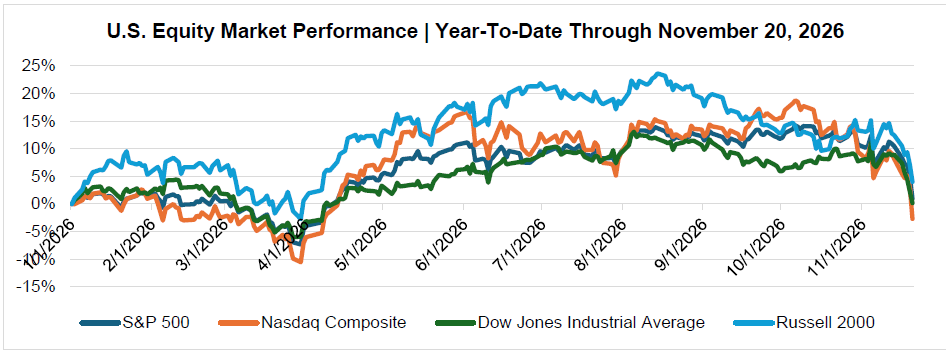
Chart 1 | Y-Charts | U.S. Equity Market Performance | Year-To-Date Through November 20, 2026
Market Corrections are a Normal Part of Investing
A market correction occurs when stocks decline at least 10% from a recent high, while a deeper decline of 20% or more is considered a bear market. While these pullbacks are unsettling, they are a regular feature of financial markets, often reflecting investors adjusting their expectations for economic growth, corporate earnings, or valuations, rather than something more nefarious. Since 1980, the S&P 500 has experienced an average intra-year decline of about 14% yet generated an average annual total return of about 13.3% over that same period, showing that market pullbacks are a normal part of investing, even during periods of positive annual returns.²
Corrections rarely have the same underlying reasons. Rising interest rates and trade tensions weighed on markets in 2018. The pandemic to put it mildly, disrupted the global economy in 2020, while persistent inflation paired with aggressive Federal Reserve tightening contributed to the 2022 bear market. More recently, uncertainty surrounding tariffs triggered a correction in the spring of 2025. Each presented different challenges, but all demonstrate how markets adjust to changing economic conditions.
What’s Driving the Current Correction?
Artificial intelligence (AI) has been one of the biggest drivers of market performance in recent years, with companies committing enormous amounts of capital to data centers, advanced semiconductors and supporting infrastructure. These investments have helped fuel both economic and earnings growth, though investors have increasingly started to question whether the financial returns will justify the extraordinary spending. As such, valuations could be pressured by a slowdown in the pace of investment particularly among the large technology companies responsible for much of the market's recent appreciation.
Another concern is the increasingly interconnected nature of the AI industry. Developers, semiconductor manufacturers and data center operators are often linked through investments, financing agreements, and customer relationships. These arrangements, sometimes referred to as circular financing, have helped accelerate growth but also raise questions about how much demand originates outside the AI ecosystem. A financial setback at one major participant could affect suppliers, lenders, and investors across the industry. The scale of recent technology IPOs, including SpaceX and Anthropic, has brought additional attention to substantial capital requirements supporting this expansion.
Interest rates have added to the uncertainty. While the labor market has remained relatively resilient, inflation continues to run above the Federal Reserve's 2% target, leaving its price stability objective unmet. This has given policymakers less flexibility to ease monetary policy as they balance their dual mandate of maintaining maximum employment and stable prices. Investors are increasingly anticipating another rate increase in December. As of November 20th, futures markets were all but pricing in a 25-point increase, according to CME FedWatch³. Higher borrowing costs could weigh on corporate investment and stock valuations, particularly among technology companies whose prices reflect expectations for substantial future growth. Regulatory uncertainty, including semiconductor export restrictions, has added further pressure.
Together, these concerns have prompted investors to reassess growth expectations and valuations, contributing to a sell-off that began with technology stocks before spreading across the broader market.
Where Do Markets Stand Today⁴
The sell-off accelerated during the week ending November 20, pushing the S&P 500, NASDAQ Composite, Dow Jones Industrial Average and the Russell 2000 into correction territory. The S&P fell 3.7% on Friday, closing at 6910.39, 10% below its October 6 high, while the NASDAQ declined 5.3% and erased its gains for the year. For the week, the Dow fell 8.0%, the S&P 500 lost approximately 8.6%, and the NASDAQ tumbled roughly 10%. The Russell 2000 also fell nearly 7.5%, reflecting broad-based weakness across U.S. equity markets.
All 11 sectors of the S&P declined during the week, while the CBOE Volatility Index (VIX), commonly known as Wall Street's “fear gauge,” climbed to nearly 36 on November 20th, with readings above 30 signaling heightened investor anxiety. While elevated volatility often accompanies market declines, it does not necessarily signal further losses.
Despite the decline in stock prices, broader economic measures continue to show signs of resilience. A recent FactSet report5, shows the S&P 500 reported estimated third-quarter year-over-year earnings growth of 32.9%, with 84% exceeding earnings expectations and 74% returning stronger-than-expected revenue. Consumer spending has also remained supportive of economic growth, suggesting the market's weakness has not yet been accompanied by a comparable deterioration in economic fundamentals.
The pullback has also brought valuations closer to their historical range. As of November 20th, the S&P 500 traded at approximately 17.1x its 12-month forward looking earnings expectations, compared with its 10-year average of 19.1x. While lower valuations don't guarantee an immediate recovery, they can provide a more attractive starting point for long-term investors. Meanwhile, high-quality bonds have offered some stability as demand for U.S. Treasuries increased and longer-term yields declined.
Looking Ahead
While the recent economic correction has been uncomfortable, we believe there are reasons to remain cautiously optimistic. Corporate earnings continue to grow, consumer spending has remained resilient, and the pullback has brought stock valuations closer to historical averages. Investors will continue to monitor AI spending in financing arrangements, inflation, and Fed policy, but much of the uncertainty surrounding the next rate decision may already be reflected in market prices. We believe the recent weakness could create opportunities as market leadership broadens beyond the largest technology companies, particularly among businesses with strong balance sheets, consistent earnings and reasonable valuations. With the holiday season approaching, the possibility of a year-end rebound, including the traditionally favorable Santa Claus Rally, may provide another source of support, although seasonal trends offer no guarantee of a recovery. Volatility is a constant within markets, and the best way to face volatility is to maintain a diversified portfolio with and remain invested.
The statements provided herein are based solely on the opinions of the Osaic Research Team and are being provided for general information purposes only. Neither the information nor any opinion expressed constitutes an offer or a solicitation to buy or sell any securities or other financial instruments. Any opinions provided herein should not be relied upon for investment decisions and may differ from those of other departments or divisions of Osaic Wealth, inc. (“Osaic”) or its affiliates.
Certain information may be based on information received from sources the Osaic Research Team considers reliable; however, the accuracy and completeness of such information cannot be guaranteed. Certain statements contained herein may constitute “projections,” “forecasts” and other “forward-looking statements” which do not reflect actual results and are based primarily upon applying retroactively a hypothetical set of assumptions to certain historical financial information. Any opinions, projections, forecasts and forward-looking statements presented herein reflect the judgment of the Osaic Research Team only as of the date of this document and are subject to change without notice. Osaic has no obligation to provide updates or changes to these opinions, projections, forecasts and forward-looking statements. Osaic is not soliciting or recommending any action based on any information in this document.
Investing involves risk, including the potential loss of principal. No investment strategy can guarantee a profit or protect against loss. In general, the bond market is volatile; bond prices rise when interest rates fall and vice versa. This effect is usually pronounced for longerterm securities. Any fixed-income security sold or redeemed prior to maturity may be subject to a substantial gain or loss. Vehicles that invest in lower-rated debt securities (commonly referred to as junk bonds or high-yield bonds) involve additional risks because of the lower credit quality of the securities in the portfolio. International investing involves special risks not present with U.S. investments due to factors such as increased volatility, currency fluctuation, and differences in auditing and other financial standards. These risks can be accentuated in emerging markets.
Index performance does not reflect the deduction of any fees and expenses, and if deducted, performance would be reduced. Indexes are unmanaged and investors are not able to invest directly into any index. Past performance cannot guarantee future results.
Trading in Forecast Contracts is highly speculative and involves a high degree of risk. You may lose all funds used to enter a Forecast Contract. Market participants' expectations may not match the actual outcome of the Event, which can lead to unexpected losses. Exchanges have the authority to initiate trading halts if they deem it in the interest of Market Participants, which could prevent you from exiting positions. The value of an Event Contract depends on the outcome, typically reported by a third party. Market participants may be exposed to risk if this source reports inaccurate data or fails to report the data.
Securities and investment advisory services are offered through the firms: Osaic Wealth, Inc. and Osaic Institutions, Inc., broker-dealers, registered investment advisers, and members of FINRA and SIPC. Securities are offered through Osaic Services, Inc. and Ladenburg Thalmann & Co., broker-dealers and members of FINRA and SIPC. Advisory services are offered through Ladenburg Thalmann Asset Management, Inc., Osaic Advisory Services, LLC. and CW Advisors, LLC., registered investment advisers. Advisory programs offered by Osaic Wealth, Inc. are sponsored by VISION2020 Wealth Management Corp., an affiliated registered investment adviser.
1 Y-Charts as of 11/20/2026
2 https://www.fidelity.com/learning-center/smart-money/stock-market-correction
4 Bloomberg as of 11/20/2026
9250189