
In Hot Water: El Niño’s Role in Global Markets

What is El Niño?
The Trade Winds are a set of consistent and nearly perpetual winds that blow from East to West at the equator. In the Pacific Ocean, this typically means pushing warmer water on the ocean’s surface off the coasts of the Americas towards Asia. An El Niño Southern Oscillation (ENSO or El Niño) occurs when those winds weaken or reverse, blowing West to East. This means the warmer waters drift back towards the Americas. To be considered El Niño conditions, the Pacific Ocean must warm by at least 0.5℃. This change in the climate tends to last from spring through fall and into the winter months.₁ Fishermen off the coast of Peru first noticed the climate phenomenon in the 16th century – waters warmed, and fishing became more difficult. But this shift in climate conditions can affect more than just fish, impacting crop yields and the frequency of natural disasters.²
What Does El Niño Mean for Global Weather?
There are very distinct impacts from El Niño depending on where one looks in the world. The United States, down through Nebraska and Iowa, often experience rising temperatures, while the Midwest tends to face more severe drought conditions. In contrast, southern states are more prone to rain and thunderstorms, although the likelihood of hurricanes generally decreases (Chart 1³). Other areas around the globe experience the effects in equally diverse ways, with places like South America subject to heavy rainfall, and Africa potentially facing intensified droughts. Because this is usually a months-long pattern, day-to-day forecasts can deviate from the trend, but on average, these changes will occur across geographical regions.
Chart 1
What Other Impacts Are Realized Under El Niño Conditions?
The Pacific is the largest ocean on the planet and has an outsized impact on weather patterns due to even the smallest temperature changes. The temperature change needed to be classified as El Niño, 0.5℃ (roughly 1℉), may seem small, but a correspondingly small 1% of the water in the Pacific Ocean is enough to bury the entire United States under nearly half a mile of water.⁴ ⁵ The slightest temperature change can significantly impact crop yields. Chart 2⁶ shows the effect on the four staple, global crops during El Niño, as well as the opposite weather extreme, La Niña, in which the trade winds, instead of weakening, intensify and cool the waters of the Pacific Ocean.
During El Niño, wetter conditions in the southeastern United States and parts of South America can boost soybean production. However, drought-like conditions elsewhere can disrupt output in other regions and have even led to export controls on rice in countries like India, which produces about 24% of the global rice supply.⁷ In the United States, corn crops in areas like Nebraska and Iowa are subjected to hotter temperatures, while the Midwest is exposed to drier conditions, which can damage corn and wheat crops domestically. Internationally, the 2015-16 El Niño triggered the worst drought in southern Africa in almost half a century, cutting regional corn production by roughly 25% and driving large numbers of people into food insecurity.
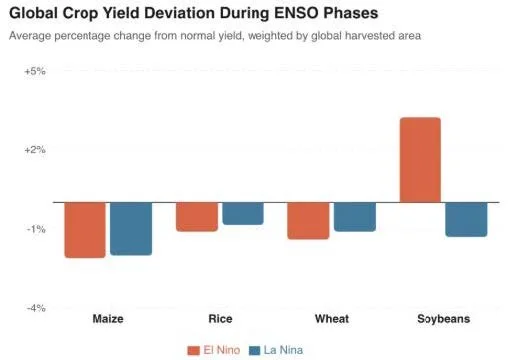
Chart 2
How Does Weather Impact Food Prices?
Crop destruction from weather-related events can drive grocery prices higher. It’s not as simple as “less corn = higher corn prices” because corn and its byproducts are used in more than 4,000 products, including ingredients like high-fructose corn syrup. Corn is also used extensively in livestock feed, ethanol fuel, and even cardboard packaging.⁸ The other staple crops exhibit similar versatility, and a decline in their overall production tends to lead to higher prices throughout the grocery store.
Beyond potential weather-related impacts on crop yields and ultimately crop prices under imminent El Niño conditions, higher fertilizer and diesel costs stemming from the closure of the Strait of Hormuz are also expected to buoy food prices later in the year.
Conclusion
There will be a variety of effects from the El Niño weather system that is anticipated to develop later this year, but El Niño weather patterns are not uncommon; they occur roughly every 3-5 years. What makes this year interesting is the magnitude of the expected change in ocean temperatures. The European Centre for Medium-Range Weather Forecasts predicts that we could see Pacific Ocean temperatures increase by more than 2℃, which would classify this year as a very strong El Niño year, surpassing a threshold that has only been breached five other times since 1950. Chart 3⁹ shows the forecasted rise in ocean temperatures this summer. For investors, it will be important to monitor commodity prices throughout the remainder of the year, as well as the subsequent impact that higher food prices may have on inflation.

Chart 3
The statements provided herein are based solely on the opinions of the Osaic Research Team and are being provided for general information purposes only. Neither the information nor any opinion expressed constitutes an offer or a solicitation to buy or sell any securities or other financial instruments. Any opinions provided herein should not be relied upon for investment decisions and may differ from those of other departments or divisions of Osaic Wealth, inc. (“Osaic”) or its affiliates.
Certain information may be based on information received from sources the Osaic Research Team considers reliable; however, the accuracy and completeness of such information cannot be guaranteed. Certain statements contained herein may constitute “projections,” “forecasts” and other “forward-looking statements” which do not reflect actual results and are based primarily upon applying retroactively a hypothetical set of assumptions to certain historical financial information. Any opinions, projections, forecasts and forward-looking statements presented herein reflect the judgment of the Osaic Research Team only as of the date of this document and are subject to change without notice. Osaic has no obligation to provide updates or changes to these opinions, projections, forecasts and forward-looking statements. Osaic is not soliciting or recommending any action based on any information in this document.
Investing involves risk, including the potential loss of principal. No investment strategy can guarantee a profit or protect against loss. In general, the bond market is volatile; bond prices rise when interest rates fall and vice versa. This effect is usually pronounced for longerterm securities. Any fixed-income security sold or redeemed prior to maturity may be subject to a substantial gain or loss. Vehicles that invest in lower-rated debt securities (commonly referred to as junk bonds or high-yield bonds) involve additional risks because of the lower credit quality of the securities in the portfolio. International investing involves special risks not present with U.S. investments due to factors such as increased volatility, currency fluctuation, and differences in auditing and other financial standards. These risks can be accentuated in emerging markets.
Index performance does not reflect the deduction of any fees and expenses, and if deducted, performance would be reduced. Indexes are unmanaged and investors are not able to invest directly into any index. Past performance cannot guarantee future results.
Trading in Forecast Contracts is highly speculative and involves a high degree of risk. You may lose all funds used to enter a Forecast Contract. Market participants' expectations may not match the actual outcome of the Event, which can lead to unexpected losses. Exchanges have the authority to initiate trading halts if they deem it in the interest of Market Participants, which could prevent you from exiting positions. The value of an Event Contract depends on the outcome, typically reported by a third party. Market participants may be exposed to risk if this source reports inaccurate data or fails to report the data.
Securities and investment advisory services are offered through the firms: Osaic Wealth, Inc. and Osaic Institutions, Inc., broker-dealers, registered investment advisers, and members of FINRA and SIPC. Securities are offered through Osaic Services, Inc. and Ladenburg Thalmann & Co., broker-dealers and members of FINRA and SIPC. Advisory services are offered through Ladenburg Thalmann Asset Management, Inc., Osaic Advisory Services, LLC. and CW Advisors, LLC., registered investment advisers. Advisory programs offered by Osaic Wealth, Inc. are sponsored by VISION2020 Wealth Management Corp., an affiliated registered investment adviser.
—
1 Your Complete Guide To Everything El Niño | Weather.com
2 First recorded “El Niño” | Environment & Society Portal
3 What is the El Niño–Southern Oscillation (ENSO) in a nutshell? | NOAA Climate.gov
4 Facts About Pacific Ocean – Geology In
5 US' Total Size & Land Area: rank & territory types [2026]
7 Rice Production by Country 2026
8 Consumer Q&A: From Corn Uses to Egg Labels to Cooking with Herbs
9 How confident should we be in a prediction of El Niño? | ECMWF
8922877