
Global Rearmament in Motion

The Price of Protection
Rising geopolitical tensions in recent years have pushed national security back into focus. Defense spending increased rapidly in 2022 after Russia invaded Ukraine and escalated further as tensions in the Middle East rose.
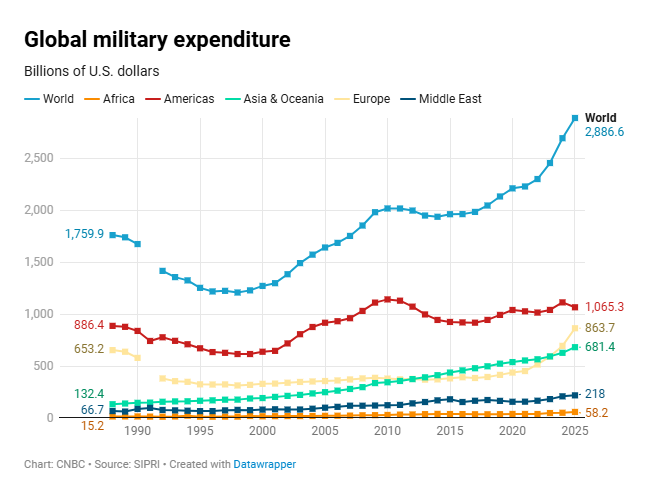
This shift is evident in the data. Global military spending reached a record $2.9 trillion in 2025, marking the 11th consecutive year of growth. Defense spending across Europe alone rose approximately 14% to $864 billion,¹ with European NATO members experiencing their fastest increase since 1953, reflecting both urgency and a push toward greater self-reliance.
Germany stands out as a key example, accelerating spending to $114 billion² and ranking as the world’s fourth-largest military spender as it modernizes its forces after years of underinvestment. More broadly, Europe is beginning to reduce its reliance on the United States for military assets.
While increases in Asia have been more gradual, defense spending across the region continues to rise steadily, as well, driven by ongoing geopolitical tensions and long-term modernization efforts, reinforcing the fact that this is a global, not regional, trend.
In addition to increases abroad, the United States remains the clear leader in global defense spending, allocating $954 billion in 2025, far exceeding any other country. Looking ahead, spending is expected to remain elevated, with Congress already approving over $1 trillion in defense spending for 2026.² Ongoing conflicts and long-term military investment targets suggest this upward trend is likely to persist, with the U.S. continuing to play a central role in driving global defense expenditures.
1. https://www.cnbc.com/2026/04/27/global-military-spending-record-2025-europe-asia-ukraine-sipri.html
2. https://www.cnn.com/2026/04/27/world/world-military-spending-report-sipri-intl-hnk-ml
The statements provided herein are based solely on the opinions of the Osaic Research Team and are being provided for general information purposes only. Neither the information nor any opinion expressed constitutes an offer or a solicitation to buy or sell any securities or other financial instruments. Any opinions provided herein should not be relied upon for investment decisions and may differ from those of other departments or divisions of Osaic Wealth, inc. (“Osaic”) or its affiliates.
Certain information may be based on information received from sources the Osaic Research Team considers reliable; however, the accuracy and completeness of such information cannot be guaranteed. Certain statements contained herein may constitute “projections,” “forecasts” and other “forward-looking statements” which do not reflect actual results and are based primarily upon applying retroactively a hypothetical set of assumptions to certain historical financial information. Any opinions, projections, forecasts and forward-looking statements presented herein reflect the judgment of the Osaic Research Team only as of the date of this document and are subject to change without notice. Osaic has no obligation to provide updates or changes to these opinions, projections, forecasts and forward-looking statements. Osaic is not soliciting or recommending any action based on any information in this document.
Securities and investment advisory services are offered through the firms: Osaic Wealth, Inc. and Osaic Institutions, Inc., broker-dealers, registered investment advisers, and members of FINRA and SIPC. Securities are offered through Osaic Services, Inc. and Ladenburg Thalmann & Co., broker-dealers and members of FINRA and SIPC. Advisory services are offered through Ladenburg Thalmann Asset Management, Inc., Osaic Advisory Services, LLC. and CW Advisors, LLC., registered investment advisers. Advisory programs offered by Osaic Wealth, Inc. are sponsored by VISION2020 Wealth Management Corp., an affiliated registered investment adviser.
8921866