
The Generational Wealth Gap Has Never Been Larger

The concentration of wealth among older Americans continues to reach historic levels. Americans aged 70 and older now hold nearly one-third of total U.S. household wealth. While wealth naturally accumulates over time, the growing disparity between younger and older generations is notable. At the end of the 1980s, the difference in wealth held between these age groups was roughly 7%; today, that gap has expanded to nearly 26%, a more than 270% increase.¹
Several structural trends have contributed to this widening divide, including demographic shifts, longer life expectancy, and the significant appreciation of financial and real assets over the past few decades, particularly following the 2008 financial crisis and the COVID-19 pandemic. At the same time, younger generations have faced greater barriers to wealth creation, including elevated housing costs, rising education expenses, and wage growth that has generally trailed inflation. Housing, historically one of the most effective vehicles for building wealth, has become increasingly difficult for many younger adults to access.
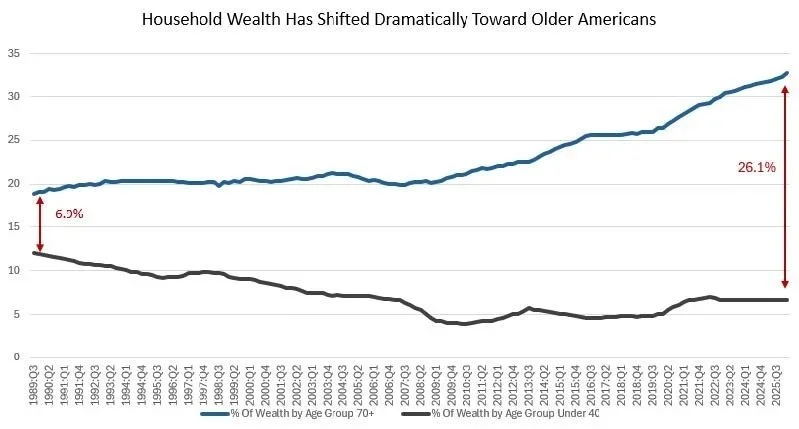
Household Wealth Has Shifted Dramatically Toward Older Americans
In this environment, the economic importance of older generations has increased, as strong balance sheets and the wealth effect from rising stock markets and home prices continue to support spending on travel, leisure, healthcare, and other services. Looking ahead, the expected acceleration of the great wealth transfer may gradually rebalance wealth ownership as trillions of dollars in assets are passed to younger generations over the coming decades.
Disclosures
The statements provided herein are based solely on the opinions of the Osaic Research Team and are being provided for general information purposes only. Neither the information nor any opinion expressed constitutes an offer or a solicitation to buy or sell any securities or other financial instruments. Any opinions provided herein should not be relied upon for investment decisions and may differ from those of other departments or divisions of Osaic Wealth, Inc. (“Osaic”) or its affiliates.
Certain information may be based on information received from sources the Osaic Research Team considers reliable; however, the accuracy and completeness of such information cannot be guaranteed. Certain statements contained herein may constitute “projections,” “forecasts” and other “forward-looking statements” which do not reflect actual results and are based primarily upon applying retroactively a hypothetical set of assumptions to certain historical financial information. Any opinions, projections, forecasts and forward-looking statements presented herein reflect the judgment of the Osaic Research Team only as of the date of this document and are subject to change without notice. Osaic has no obligation to provide updates or changes to these opinions, projections, forecasts and forward-looking statements. Osaic is not soliciting or recommending any action based on any information in this document.
Investing involves risk, including the potential loss of principal. No investment strategy can guarantee a profit or protect against loss. In general, the bond market is volatile; bond prices rise when interest rates fall and vice versa. This effect is usually pronounced for longer-term securities. Any fixed-income security sold or redeemed prior to maturity may be subject to a substantial gain or loss. Vehicles that invest in lower-rated debt securities (commonly referred to as junk bonds or high-yield bonds) involve additional risks because of the lower credit quality of the securities in the portfolio. International investing involves special risks not present with U.S. investments due to factors such as increased volatility, currency fluctuation, and differences in auditing and other financial standards. These risks can be accentuated in emerging markets.
Index performance does not reflect the deduction of any fees and expenses, and if deducted, performance would be reduced. Indexes are unmanaged and investors are not able to invest directly into any index. Past performance cannot guarantee future results.
Securities and investment advisory services are offered through the firms: Osaic Wealth, Inc. and Osaic Institutions, Inc., broker-dealers, registered investment advisers, and members of FINRA and SIPC. Securities are offered through Osaic Services, Inc. and Ladenburg Thalmann & Co., broker-dealers and members of FINRA and SIPC. Advisory services are offered through Ladenburg Thalmann Asset Management, Inc., Osaic Advisory Services, LLC. and CW Advisors, LLC., registered investment advisers. Advisory programs offered by Osaic Wealth, Inc. are sponsored by VISION2020 Wealth Management Corp., an affiliated registered investment adviser.
_____
1 The Fed - Table: Distribution of Household Wealth in the U.S. since 1989
9031855