
The 2026 Midterms: Staying the Course
Why the Election Matters to Investors
With the November 3rd midterm elections fast approaching, investors naturally wonder what Washington's next chapter could mean for their investments. Campaign news and candidate platforms are discussed every day, often accompanied by predictions about tax policy, prices, and the stock market. For investors, the instinct to protect their savings can be powerful, but it is important to remember that an election does not, by itself, immediately change American businesses' earnings potential – earnings growth remains the most critical driver of stock market returns – or the long-term purpose of a well-built portfolio. Political uncertainty typically lasts weeks, not years, and once the election results are in, investors tend to refocus on economic fundamentals, which remain very strong.
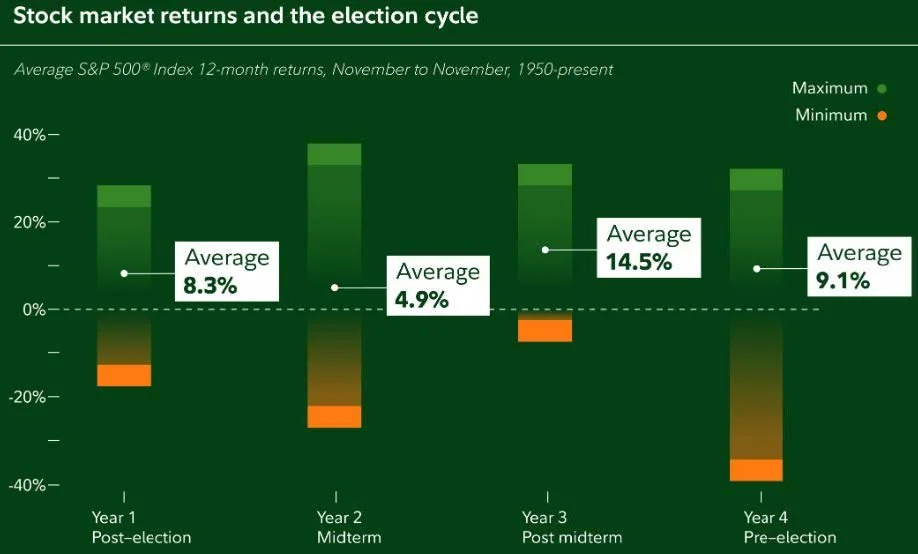
Chart 1 | Stock market returns and the election cycle
What History Shows
As Chart 1¹ shows, since 1950, the S&P 500 has averaged a 14.5% gain in the third year of a presidential term, while midterm election years tend to deliver the worst performance, with the S&P 500 returning 4.9%. The point is not to assume the pattern will repeat in 2026, especially given markets are already up double digits this year,² but rather to recognize that a tense political environment, the election of a particular candidate, or a partisan sweep has not been a dependable signal to sell stocks. In fact, the opposite is true: periods of volatility tend to be brief, and investors who weather the storm are often rewarded.
What the Midterm Results Could Change
Congress helps shape tax legislation, federal spending, and government funding decisions. A change in congressional control would not necessarily produce a major policy reversal: some priorities may continue through executive agencies, and a divided government could make large new legislation harder to pass. Budget negotiations and other fiscal disputes could still create uncertainty. Those issues are sure to create more headlines but will have little to no impact on corporate earnings or the business environment at large. Investors are weighing economic pressures that will matter regardless of the ballot count. Investors should remain focused on economic data and corporate earnings because those factors are far more critical for markets than election results or the political party in power over the long term.
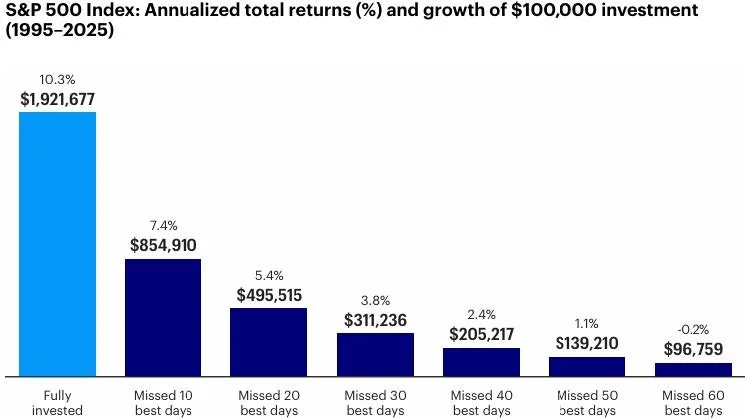
Chart 2 | S&P 500 Index: Annualized total returns (%) and the growth of $100,000 investment (1995-2025)
Why You Should Stay Invested
The temptation to sell positions and return to the market after the headlines settle creates two decisions: when to leave and when to buy back. Getting either wrong can mean missing all or part of a market rally. Chart 2³ highlights an investment of $100,000 in the S&P 500 Index and the effect of missing the best days of market performance over the last 30 years. Missing only the 10 best days can cut portfolio returns by over 50%, emphasizing the fact that time in the market is far more important than timing the market. Chart 3⁴ looks at the average return in the year after midterms going back to 1950. Not only does the average return tend to be higher than in other years, but since 1950 the S&P 500 has not delivered a single negative return in the year after midterm elections. In the end, markets care much more about the stability of the democratic system and the fact that elections are taking place, and care much less about which party wins a given election.
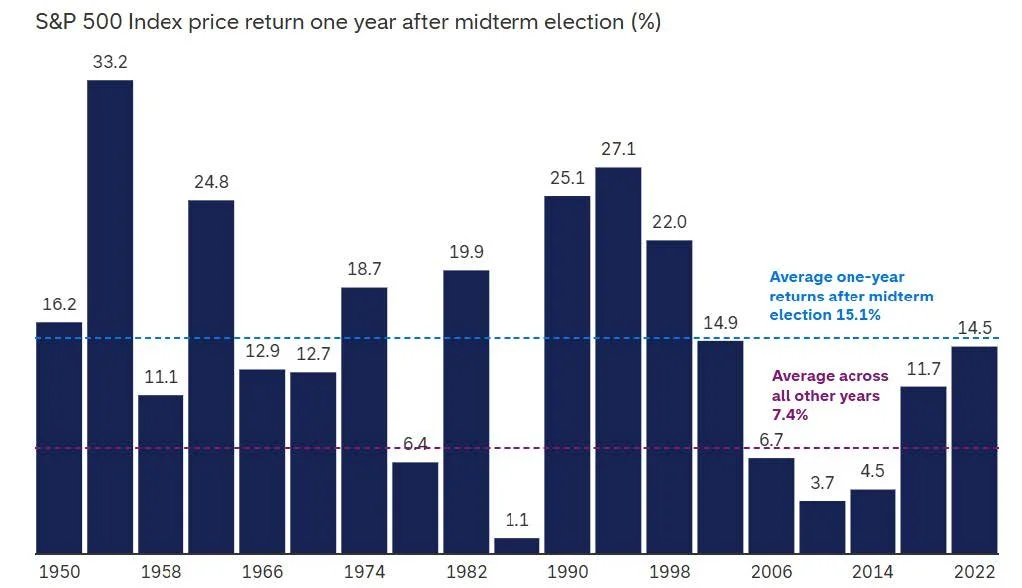
Chart 3 | S&P 500 Index price return one year after midterm election (%)
Staying Focused on What Matters
Political developments are worth following, but they should be viewed alongside the goals a portfolio is meant to serve. An investor who needs funds soon may reasonably hold more cash or short-term investments than someone saving for retirement decades away. For a long-term investor, a diversified allocation, periodic rebalancing, and an honest review of risk tolerance are more useful than attempting to trade around election predictions. Staying invested does not mean ignoring risks or maintaining a static portfolio. It means making changes for a clear financial reason and not capitulating to political headlines that drive volatility and make the next few weeks feel uncertain.
The statements provided herein are based solely on the opinions of the Osaic Research Team and are being provided for general information purposes only. Neither the information nor any opinion expressed constitutes an offer or a solicitation to buy or sell any securities or other financial instruments. Any opinions provided herein should not be relied upon for investment decisions and may differ from those of other departments or divisions of Osaic Wealth, inc. (“Osaic”) or its affiliates.
Certain information may be based on information received from sources the Osaic Research Team considers reliable; however, the accuracy and completeness of such information cannot be guaranteed. Certain statements contained herein may constitute “projections,” “forecasts” and other “forward-looking statements” which do not reflect actual results and are based primarily upon applying retroactively a hypothetical set of assumptions to certain historical financial information. Any opinions, projections, forecasts and forward-looking statements presented herein reflect the judgment of the Osaic Research Team only as of the date of this document and are subject to change without notice. Osaic has no obligation to provide updates or changes to these opinions, projections, forecasts and forward-looking statements. Osaic is not soliciting or recommending any action based on any information in this document.
Investing involves risk, including the potential loss of principal. No investment strategy can guarantee a profit or protect against loss. In general, the bond market is volatile; bond prices rise when interest rates fall and vice versa. This effect is usually pronounced for longerterm securities. Any fixed-income security sold or redeemed prior to maturity may be subject to a substantial gain or loss. Vehicles that invest in lower-rated debt securities (commonly referred to as junk bonds or high-yield bonds) involve additional risks because of the lower credit quality of the securities in the portfolio. International investing involves special risks not present with U.S. investments due to factors such as increased volatility, currency fluctuation, and differences in auditing and other financial standards. These risks can be accentuated in emerging markets.
Index performance does not reflect the deduction of any fees and expenses, and if deducted, performance would be reduced. Indexes are unmanaged and investors are not able to invest directly into any index. Past performance cannot guarantee future results.
Trading in Forecast Contracts is highly speculative and involves a high degree of risk. You may lose all funds used to enter a Forecast Contract. Market participants' expectations may not match the actual outcome of the Event, which can lead to unexpected losses. Exchanges have the authority to initiate trading halts if they deem it in the interest of Market Participants, which could prevent you from exiting positions. The value of an Event Contract depends on the outcome, typically reported by a third party. Market participants may be exposed to risk if this source reports inaccurate data or fails to report the data.
Securities and investment advisory services are offered through the firms: Osaic Wealth, Inc. and Osaic Institutions, Inc., broker-dealers, registered investment advisers, and members of FINRA and SIPC. Securities are offered through Osaic Services, Inc. and Ladenburg Thalmann & Co., broker-dealers and members of FINRA and SIPC. Advisory services are offered through Ladenburg Thalmann Asset Management, Inc., Osaic Advisory Services, LLC. and CW Advisors, LLC., registered investment advisers. Advisory programs offered by Osaic Wealth, Inc. are sponsored by VISION2020 Wealth Management Corp., an affiliated registered investment adviser.
1 How might midterm elections impact the stock market? | Fidelity
2 Data Obtained from Bloomberg as of 10.16.2026
3 Timing the market rarely works
4 How U.S. midterm elections may affect markets | Capital Group
9197362